
We Just Got an AAC Device… Now What? (Part 3 of 3) - Real Life Modeling Examples for Home
Welcome back to part 3 of my series, We Just Got an AAC Device... Now What? If you missed the previous posts, you can catch up here:
Last week we introduced one of the most important skills a parent can learn: modeling. Modeling means you (the parent) point to words on the device as you speak.
So here we go with part 3.
This is the question I hear constantly:
"When I'm modeling, what do I actually press on the AAC device?"
When you're starting out, you don't need to model long sentences. You don't need to model perfectly. You can start with a few words on the home page of the device.
AAC Modeling Examples for Everyday Routines at Home
I find that examples are the most helpful way to learn what to model.
Below, you'll see examples of phrases I might say to a child. I'm speaking the full phrase, but only modeling certain key words on the AAC device (the words highlighted in bold). I've also included some pictures below each example so you can see what this might look like on some AAC apps.
Try following along with your child's device in front of you and practice finding some of these words as you read through the examples.
Getting ready for school:
I put on my socks.
Could you help me mom?
It is hot today!
Where did my backpack go?
I am all done/finished getting ready.
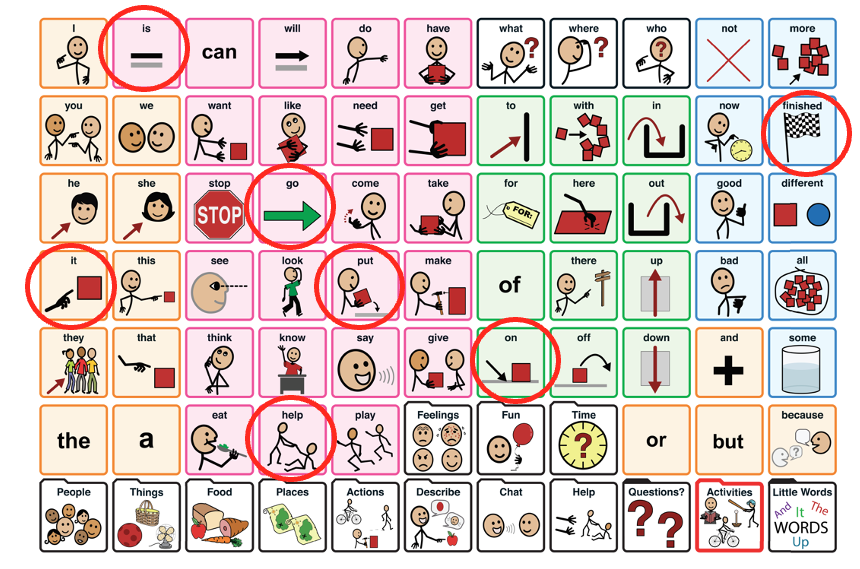
Home page of the Proloquo2Go AAC application with core words circled from the examples above.
Leaving the house:
Let's go to school.
Stop! Wait a minute dad!
Put my bag in the car.
Race you out the door!
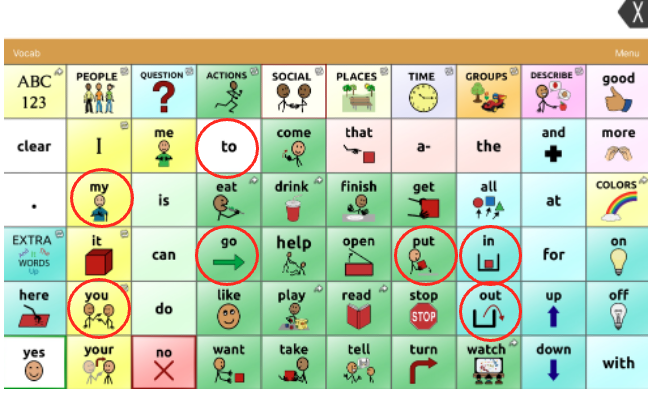
Home page of the Touch Chat AAC application with core words circled from the examples above.
Snack Time:
Who ate my crackers?
Are there more grapes?
I like peanut butter
I do not/don't like jelly.
Help me.
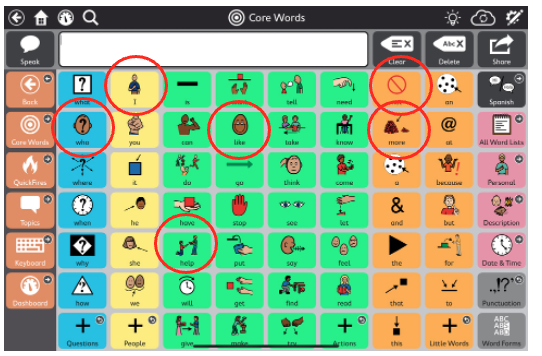
Home page of the TD Snap AAC application with core words circled from the examples above.
When They’re Upset: (this one is important!)
Stop, I need space.
No, I don’t like when you take the remote.
I’m (get)ing mad.
No more homework!
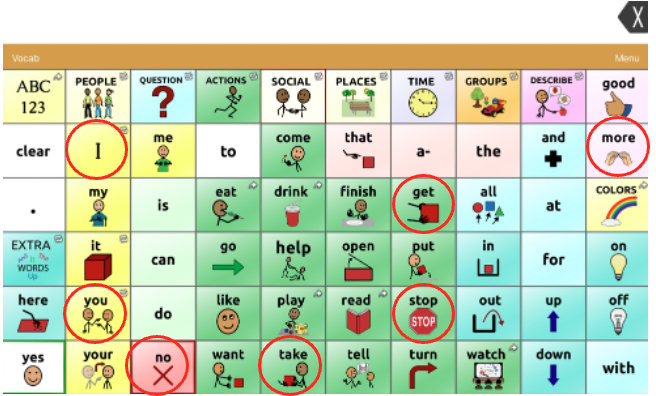
Home page of the Touch Chat AAC application with core words circled from the examples above.
Why It's Important to Model AAC for Big Feelings, Too
When modeling, remember that AAC is not just for polite requests like “I want _.” It is important to model words to protest, comment, share an opinion, and crack a joke. AAC is for real life.
If this still feels overwhelming, remember: Learning AAC as a parent takes time! You are doing the work to learn and that's what matters!
Hopefully seeing a few of these examples helps modeling feel a little easier.
Want help applying these examples to your child's device?
I offer virtual AAC parent coaching across Washington state. We brainstorm how to model, where to find words on the device, and when are the best times to integrate AAC into your life at home. Sessions are practical and focused on your specific routines.
If you're in the Seattle area, I also offer in-home AAC speech therapy, where I work directly with you and your child to support AAC access and communication growth.
And if you've been following this series, thank you. You're doing the work. That matters.
Further Reading & Sources
AssistiveWare. "Modeling with AAC" video tutorial
Disclaimer: This blog provides general educational information related to speech and language development and augmentative and alternative communication (AAC). Content reflects a combination of cited resources, clinical experience, and professional expertise. It is not intended as medical or therapeutic advice and does not replace a comprehensive evaluation by a licensed speech-language pathologist or other qualified professional. Reading this content does not establish a provider-client relationship.