
Let’s dig in a little more into modeling beyond requesting.
In my last post (What to Model Besides “I Want”) we talked about three strategies to model more than “I want”: observing what your child is doing and attributing meaning, the +1 rule, and thinking like a kid!
Next, let’s talk about communication functions.
Communication Functions
Communication functions are also known as the reasons we communicate.
There are LOTS of reasons we communicate beyond requesting. Here are a few:
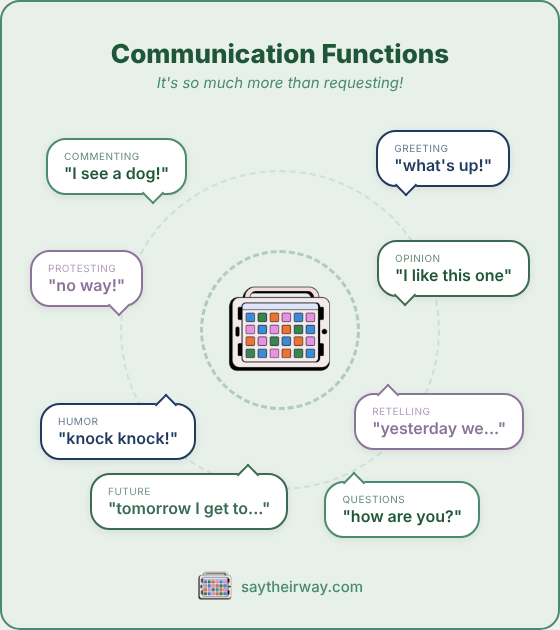
Commenting – I have, I see, it has
Protesting – no way, I don’t like this, nope, not cool
Sharing opinions – I like, I love, that’s cool, that’s hilarious
Asking questions – what’s your name, how are you
Answering questions – yes, no way, that one
Greeting/Farewells – hi, what’s up, see ya later
Retelling events – yesterday I, last year we
Talking about the future – tomorrow I get to, I can’t wait for my vacation next month
Socializing – come hang out with me, let’s play this game
Humor – 6-7, fart jokes, knock-knocks
And more!
So how do you get your child to start saying more of these on their AAC?
YOU have to show them! Meaning, you’ve got to be modeling how the device can be used for all these things, and not just for saying “I want.”
A little challenge for you: Swap the “I want”
Next time you’re modeling and you find yourself just pressing “want,” pick a different communication function and try to model that instead.
I’m going to take a few everyday situations and show you what it looks like to swap requesting for different communication functions.
Remember, we are modeling WITHOUT expectation, meaning we are pressing the words as we speak and not expecting anything from the child in return. Let them watch you!
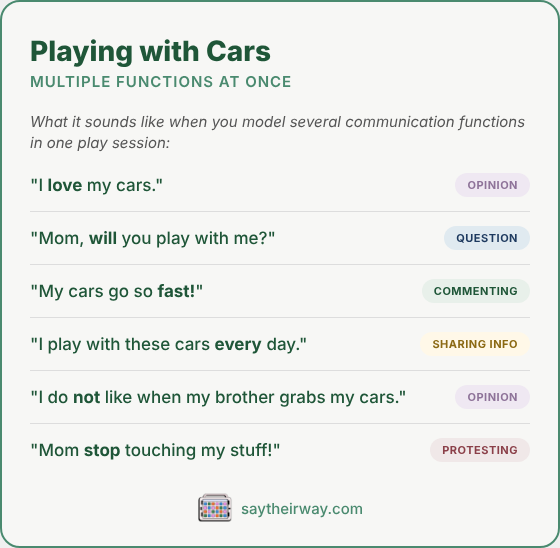
Playing with cars
Your instinct might be to model “I want car” every time your child picks one up. Let’s switch it up!
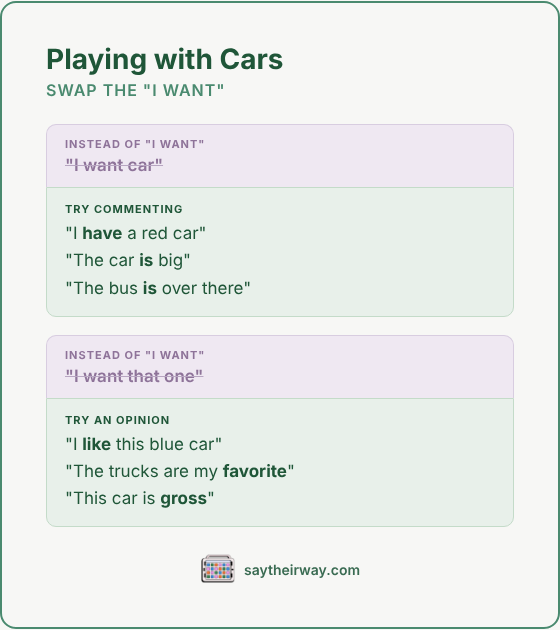
Remember, you don’t have to model every word as you’re staring, I bolded a few you might start with.
Mealtime
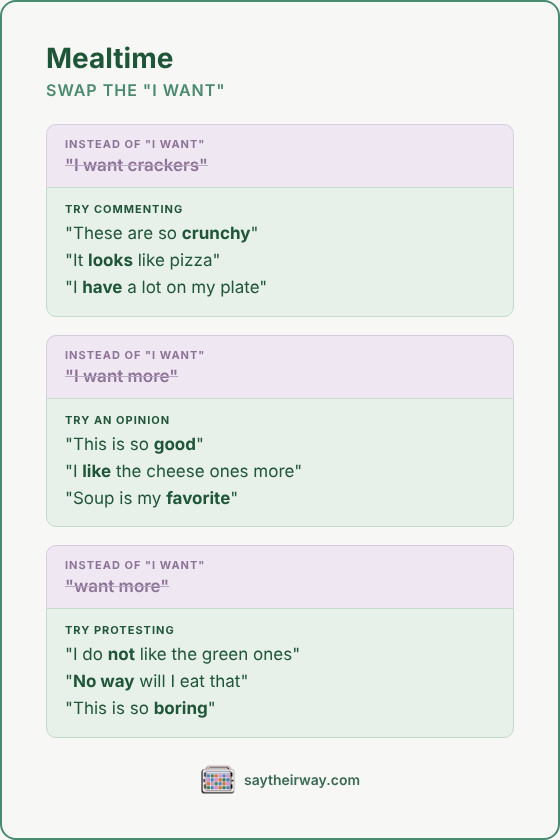
Mealtime is one of the easiest places to get stuck on requesting. It’s also a great place to “swap the ‘I want’” because food is SO fun to talk about!
Reading a book together
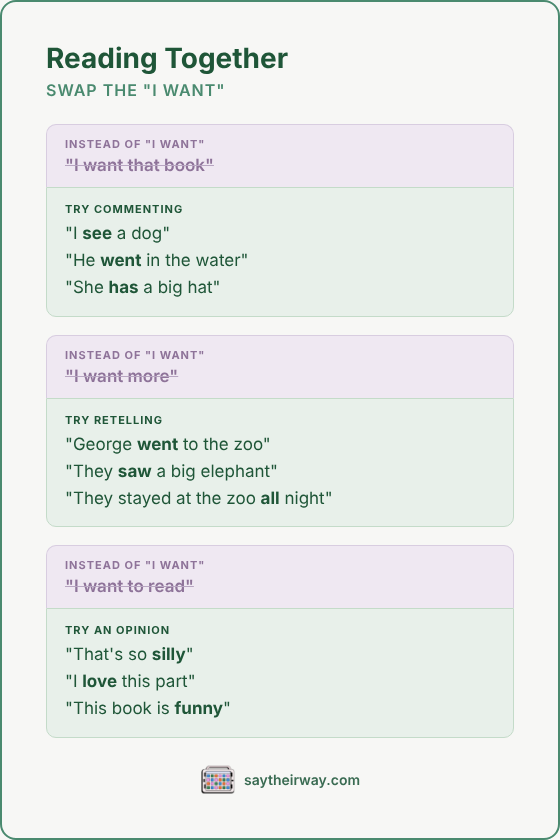
Reading is a great place to “swap the ‘I want’,” because there’s so much happening on every page.
Can I model multiple communication functions at the same time?
Yes!
In the examples above, I set a small goal of picking just one communication function to build my skills. Maybe you’re further along in your modeling journey and want to model multiple functions in one session. That is GREAT! That’s what I do during all my speech therapy sessions. Here’s what that might sound like in the car scenario:
If you want more ideas for modeling during everyday routines like meals, check out my post on real life modeling examples for home.
A few reminders
Like I mentioned in Part 1, you can start by pressing core words to begin your modeling journey. As you get better (you’ve GOT to practice), before you know it you’ll be modeling full sentences on the device.
Also, sometimes you need a bit of help to find fun and motivating words. If you want to model “disgusting” or “red” or “bus” and don’t know how to find it, use the search feature. Video links included below!
Something to reflect on
Think about all the different things YOU say in your day. I’m guessing it’s more than just “I want.” Take inventory of what you’re saying and try modeling the same for your child on their device. They deserve the chance to say all those things too!
Want more support?
I’m Haley, a speech-language pathologist in Seattle, and AAC is what I do all day. If you’re looking for more support using these strategies with your own child, students, or clients, I offer 1:1 AAC coaching for parents and teachers! Reach out and we can brainstorm specific ways to model beyond requesting.
You can learn more on my Services page, or by checking out this post AAC Parent Coaching in Washington: How It Works and When It Helps.
Further Reading & Resources
Sennott, S. C., Light, J. C., & McNaughton, D. (2016). AAC modeling intervention research review. Research and Practice for Persons with Severe Disabilities, 41(2), 101–115.
AAC Language Lab - Communication Functions Handout
Assistiveware - Communication Partner Skills for AAC Learners (includes a great video on Attributing Meaning)
Assistiveware - Communication Functions: All the Reasons We Communicate
This blog provides general educational information related to speech and language development and augmentative and alternative communication (AAC). Content reflects a combination of cited resources, clinical experience, and professional expertise. It is not intended as medical or therapeutic advice and does not replace a comprehensive evaluation by a licensed speech-language pathologist or other qualified professional. Reading this content does not establish a provider–client relationship. Any external organizations or programs mentioned are shared as informational resources only and do not constitute an endorsement or recommendation.